Showing posts with label shooterKRYS. Show all posts

Monday, 24 August 2015

A Requesting Letter

Dear Audience,
I Kartik Rawal, phgr. @ YPS humbly request you all to Please! Please!,

Visit the two of given links

and Like The two Pictures.

Again requesting you all to accept this Request

Thank You!


(If you want than you can also participate in it)

Saturday, 13 June 2015

9 creative photo ideas to try in June

As part of our ongoing series to help you get more creative with your digital camera, each month we publish some fun, seasonal, creative photo ideas to help inspire your imagination. Along with some amazing images, we’ve also provided some quick photography tips by both amateur and professional photographers who are experts in these fields.
We’re kicking off June with a new list of exciting photo projects like making 3D images, shooting solely with a 50mm lens, making composites and planning your travel photography!

01. Hit the road
Phgr. Kartik Rawal

While the road trip tends to be more associated with novels like On the Road and iconic movies like Easy Rider, photographers have long been inspired by the open road’s visual possibilities and promise of adventure.

Don’t worry though if you don’t have Monument Valley or Route 66 within striking distance, as the spirit of open-road photography can be channelled wherever you are in the world.
This stunning image was taken by photographer Kartik Rawal during a photographic trip to Mount Abu.

“We were lucky with the weather because it’s very unusual to get such sunny day in ABU. For this image, I used a Canon EOS 5D Mark II SLR with a 17-40mm f/4 lens and graduated Neutral Density filter.” Kartik says

While it may be hard to find an open road that stays empty for very long in the cities, the classic image of tarmac snaking into an undiscovered distance remains as alluring and compelling as ever. 

Get started today

  • While you don’t need a totally empty road for this kind of image, it helps with impact, so be prepared to get up well before the traffic. The light tends to much better just after sunrise as well


  • You can borrow many techniques and tips from landscape photography – use a tripod (where it’s safe to do so) to keep shots sharp, and set a narrow aperture (higher f number) to maximise depth of field and front to back sharpness. Don’t set too narrow an aperture, however, as your image can end up softer because of diffraction


  • Kartik used a graduated ND filter to balance the sky with the middle and foreground, ensuring each section was well exposed. If you don’t have a filter on you, the Graduated Filter tool in Lightroom can also help to give dramatic skies with well-lit foregrounds but use it sparingly. Fixing bad underexposure will also generate noise.


  • Try to avoid distractions and clutter by the side of the road, like litter bins, bus shelters and so on.


Stay tuned For more!...

Thursday, 21 May 2015

Guide To LONG EXPOSURES

What is a long exposure and why is it an important technique for photographers?
If you’re new to photography you might understandably have a few questions about how to shoot a long exposure.
In our latest YPS guide we answer some of the most common questions asked by new photographers.

What is a long exposure?

When you start photography, the basic aim is to take a photograph that is exposed correctly while hand-holding your camera.
But as you develop your skills, you’ll discover that a whole range of creative outcomes are possible when you allow the camera’s exposure – the period of time the shutter is actually open so light reaches the sensor – to last for a period running into several seconds, minutes, even hours in some cases.

What is the drawback(Limitation) of a long exposure?

The most obvious drawback of a long exposure is being able to hold the camera steady enough and avoid any risk of camera shake ruining the shot by causing the things you want to remain solid and fixed within the scene to blur as well.
If your shutter speed is as slow as 1/30sec, there’s a real chance of camera shake; when the exposure lengthens to several seconds or more, camera shake is basically unavoidable if you are hand-holding. When it comes to shooting long exposures a sturdy tripod is definitely required.

When would I use a long exposure?

In low-light situations, such as shooting a sunrise or sunset, you may have little choice other than to choose a long exposure. While it’s possible to increase ISO to improve shutter speed, this isn’t always the best way.
Therefore, fixing the camera to your tripod and allowing it to expose for several seconds at a low ISO is unavoidable.
Long-exposure techniques have gained hugely in popularity over recent years, and many photographers now use light blocking filters so they can take long exposures even in bright conditions.
Dam Angore

Why would you deliberately want to shoot a long exposure?

This is purely for the creative effect it has on the outcome of the image. When exposures run into seconds or minutes, any moving subjects that are in the shot will become blurred.
How much they blur will depend on the speed they are moving at and how long the exposure is. You’ll see that moving water will take on a milky appearance, clouds will streak across the sky, wind-blown foliage will become fuzzy or a crowd of people on the street will blur.
While many photographers love these effects, there are others who hate them! Personally, I think that injecting a sense of movement into the right image can often make it look more interesting, but you need to be aware that the effect can also be overdone.
The real key is to combine something solid and fixed within the composition with the moving element. This is why coastal scenes with mooring posts or rocks around which water can blur are very popular with photographers.

Thursday, 14 May 2015

Hurrray! Again a Nomination

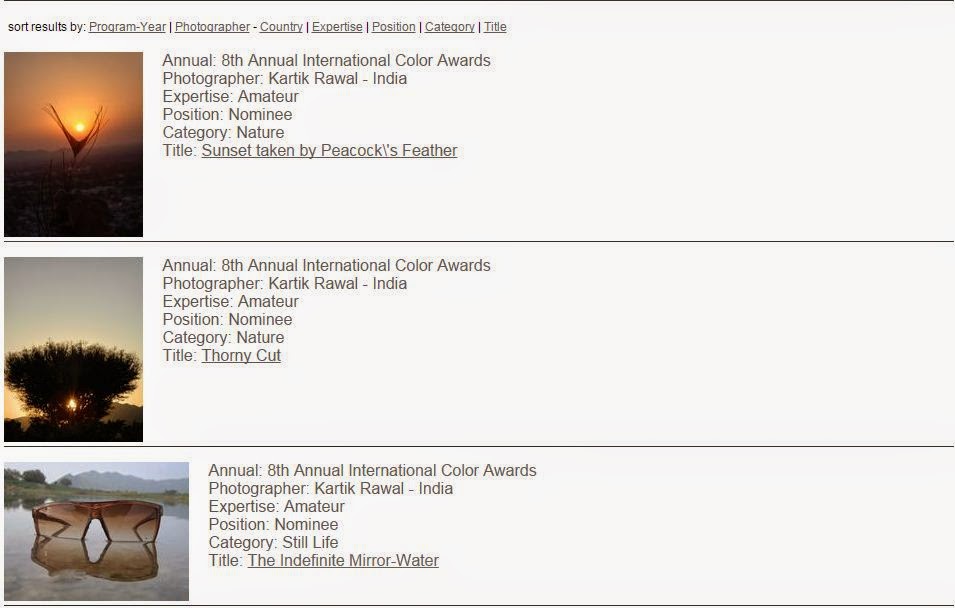
Our brilliant Photographer KARTIK RAWAL Again got Nominated in a International Photo Contest But this time with more number of photos and Votes.

International Color Awards
NOMINATED
The Medal
Kartik Rawal's Nominated Pics

Monday, 6 April 2015

How to make a DIY macro lens?


Macro lenses are brilliant optics, but you don’t need to spend much for one if you’re just a casual macro photographer. In our latest DIY Photography Tricks post we show you how to make a DIY macro lens using a simple cardboard tube…
If macro photography is your passion, spending a few Thousand rupees on a decent macro lens is a must. Altertnatively, you could get an extension tube or a close-up filter to enlarge your subject. But what if you want to get really close to your subject without the expense, perhaps just to try macro out?
It’s surprisingly easy to convert a standard lens into a macro, using nothing more than a cardboard tube, an old camera body cap and some tape…

How to make a DIY macro lens

01 Make a camera fitting
Start with a way to attach the lens to the camera. Find an old body cap. Drill a few holes on the inside, then use a small saw or a file to create an aperture in the middle.

02 Find a tube
We need distance between the sensor and lens to extend the focal length. Find a cardboard tube with roughly the same diameter as the body cap.

03 Prepare the tube
Cut the tube to about 15cm: this will vary depending on your lens you use, but it’s a good starting length. To stop light from bouncing around, stick black paper inside.

04 Fit the lens
Use insulation tape to stick the body cap inside the tube. With the front of the lens facing the tube, tape it in place so the end that usually fits onto the camera is exposed.

05 Set the aperture
On the back of the lens is a lever that camera uses to set the aperture. Position it so that the aperture is fully open and fix it with tape.
06 Start shooting!
In your camera’s menu, activate the setting that enables the camera to shoot without a lens. Fix the camera on a tripod, set to Manual and take a few test shots.
Final tip
When you shoot, you’ll need to adjust the shutter speed to get the correct exposure. To focus, change the camera’s distance from the subject.

Source: DIY Photography

9 creative photo ideas to try in April 2015

As part of our ongoing series to help you get more creative with your digital camera, each month we publish some fun, seasonal, creative photo ideas to help inspire your imagination. Along with some amazing images, we’ve also provided some quick photography tips by both amateur and professional photographers who are experts in these fields.
We’re introducing April with a new list of exciting photo projects like brooding landscapes, portraits of mothers and babies, creative forests and even selling your images!

Creative photo ideas for April: 01 Shoot brooding landscapes


Trying to come up with new ways of shooting landscapes is always a good idea. It’s all too easy to fall into clichés with the landscape genre, and rely too much on tried and tested techniques that produce rather predictable images.
Kartik Rawal went to the popular landscape Jungle of Sirohi-KalkaJi, but managed to come back with something very special indeed by shooting with an DSLR, then doing some creative experimentation afterwards in Photoshop.
Kartik, whose project on deserted roads has also attracted lots of attention, explains he has been taking pictures most of his life, but became a little more obsessive about it 10 years ago while filming a documentary for Surat city.
“Getting lost is half the fun,” says Kartik of his photographic travels.
Get started today
#1   Converting your camera to infrared can yield great results – but do bear in mind that it’s a very bold step to take, as the process cannot be reversed.
#2   “Once you have found the subject you wish to shoot, be aware of its surroundings – how do they interact with your subject?” says Kartik.
#3   Kartik points, you should think carefully about how light affects the subject. “Will waiting for the ‘right light’ helps you much? A different time of day maybe, if you’re lucky?”
#3   “Then use these elements to help build a narrative for the image,” Kartik adds. “These are the stepping stones that help the viewer navigate the image and hopefully make them come back and see something different on the second viewing.”

Monday, 16 March 2015

Sunday, 1 March 2015

500Px

Now visit us on 500px @
https://500px.com/shooterKRYS
Follow us there
#follow4followback